


“A reader lives a thousand lives before he dies,” says Jojen Reed in George R. R. Martin’s A Dance with Dragons. “The man who never reads lives only one.”1 Well, in the past month, Taiwanese baseball fanatics sure have been “reading” and living thousands of lives over the course of hours, perhaps days.
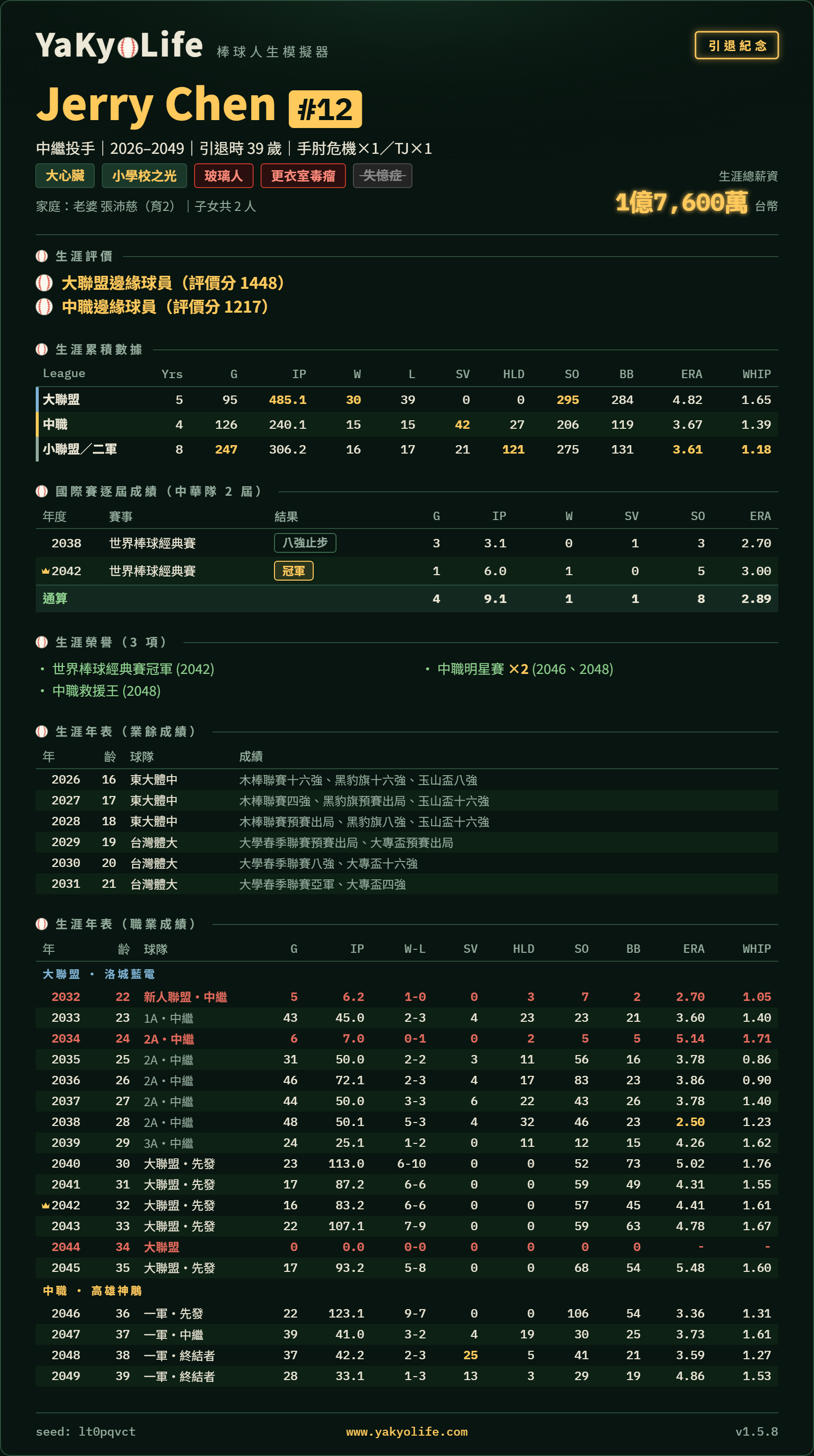
A developer by the name of Mr.TheMost vibe-coded a text-based baseball career simulator that allows players to live out the life of a randomly generated “seed” with its unique intrinsic talents and potentials. In YaKyoLife, a portmanteau of “yakyu” (Japanese and Taiwanese Hokkien word for baseball) and “life,” users make decisions about training, career moves, contracts, and even relationships,2 and then a log of career statistics and accolades is generated at the end.
A game of chance, or a story about chance?
YaKyoLife is addicting in a couple different ways. It is, by its core premise, a game of chance. Every seed is randomly generated with traits that are given to the player’s seed. A pitcher with high raw potential for velocity but has to work harder for command. A catcher with high potential for pitch selection. An outfielder who is a natural slugger.
Chance is built into each decision point for the player. At every stage, starting age 16, the first year of senior high school, dice are cast to determine the effectiveness of training, which decides how much improvement he3 sees in a particular skill, even if he is the one deciding which skill to improve.
Throughout his career, events and other decisions affect his skills, performance, and injuries, all in a probabilistic manner. In a simplistic view, the game acts a lot like a slot machine.
But the player does have some agency, especially if he is given greater potential at inception and experiences a bit of luck early on. He can choose to go to college or enter the CPBL draft. He can choose to sign with an NPB or MLB team, then return to Taiwan if he underperforms.
He can choose to forgo his defensive abilities and focus on batting as a designated hitter. Based on his performance and health, he can choose a long-term or short-term contract, when one is offered. Finally, he chooses when to retire.
We see a lot of these decisions play out in real life. Young prospects deciding between entering the CPBL draft or playing in the amateur league, or signing an NPB development contract. In this way, YaKyoLife simulates many possibilities for each seed and generates stories about chance and what can be achieved with the lot one is given.
Watching a thousand careers
At the retirement, or conclusion, of each career, a few short blurbs are generated to summarize the simulated player’s legacy. Sometimes, there may even be a hall of fame vote. Reviewing the final stats and these blurbs is not unlike reading about a random baseball player in real life. The stats are interesting, and they tell a story about where the player has gone and what he has achieved.
Many of the preset schools and career choices are familiar to Taiwanese fans:
High school: Pin-Jen, Ku-Pao, Pu-Men, Kao-Yuan, Taitung Affiliated PE (NTPEHS)
Colleges: National Taiwan University of Sport (NTUS), Chinese Culture University, Fu-Jen, Kainan
Choices: semi-pro, CPBL, NPB, MLB
These, at least in the earlier stages, are well-trodden paths of some of the biggest Taiwanese stars. For example, Detroit Tigers rookie infielder Hao-Yu Lee went to Ping-Jen and signed with the Philadelphia Phillies as an international agent upon graduation.
Former MLB pitcher Wei-Chieh Huang, who made four appearances for the Texas Rangers in 2019, went to Kao-Yuan then to the NTUS before signing with the Arizona Diamondbacks. After about a decade in the MiLB system (and a Tommy John), he returned to Taiwan and was drafted to the Wei Chuan Dragons.
Another factor that makes the game compelling and addicting is that these simulated careers are conceivable. There have been hundreds of Ping-Jen grads in the annals of professional baseball, many of whom have pursued careers abroad. The baseball schools and minor league journeys are familiar to the average Taiwanese fan.
A fusion of cultures
My observation is that the viral nature of YaKyoLife comes from its clever incorporation of both Japanese and American elements of the sport. Taiwanese baseball has Japanese roots but is heavily influenced by the modern American game.
Mr.TheMost, the game developer, talks about his admiration for former New York Yankees pitcher Kei Igawa, despite what many would consider a “failed” career:
I like the story of Kei Igawa. I think he is very special and independent-minded, [as illustrated by] his minor league career in the later years and quest to return to the majors, despite having the option to return to Japan. Even after retiring from professional baseball, he continued to play in independent leagues. His insistence to stay on the mound reminds me of the “Koshien spirit” and the image of a high school starting pitcher refusing to leave the mound, dedicating his life to pitching regardless of performance.
Japanese baseball is stereotypically associated with dedication to craft. The story of a dedicated athlete that isn’t able to reach the pinnacle of the sport is compelling to many YaKyoLife players. The game generates stories that summarize even the most average or under average of players, because Mr.TheMost believes in honoring the hard work and dignity of all players (even if fictional). Beyond his stories, many fans have even written fan fiction for players they’ve “developed.”
The American aspects of the game are a bit more obvious even to casual fans. MLB represents the largest market and highest level of play. In the game, there is the quest to achieve the biggest contract or highest earnings. Then there is one to optimize performance and win hall of fame votes. The gap in earnings potential between MLB and NPB (and between NPB and CPBL) is vast. And becoming enshrined in Cooperstown? Well, there is no bigger honor in the sport.
YaKyoLife fuses these sometimes competing goals, and players can decide for themselves what they are chasing. Regardless of the journey and outcome, there is a story that players can feel a part of and enjoy. As Mr.TheMost puts it, the game is ultimately a baseball-themed game about life, rather than a game about baseball. Judging by how many people have already lived thousands of simulated baseball careers through it, he might be onto something.
Another version, by philosopher and author Umberto Eco: “The person who doesn't read lives only one life. The reader lives 5000. Reading is immortality backwards.”
Incidentally, all possible girlfriends and wives are celebrity cheerleaders, but this feels like a meta-reference about the role of cheerleaders in Taiwanese baseball.
I should clarify, the protagonist is always a male baseball player in this game, which makes sense given the state of professional baseball in Taiwan currently.