


If you’re Taiwanese, you’ve probably heard the explanations, mostly from confident men and women in their 50s and 60s, of why Taiwanese baseball players rarely make it to MLB. The reasoning tends to be a moving target:
Taiwanese people are genetically smaller and weaker than Western races
But Taiwanese youth players don’t seem to have an issue winning international tournaments: Well, at earlier ages, these physical differences are less prominent, and Taiwanese youth players are more skillful and strategic than their foreign counterparts
But there have been some MLB players from Taiwan, even if pitchers have had more success: Well, Taiwanese pitchers can develop breaking balls to offset their disadvantages in size and speed, whereas hitters lack power so clearly cannot succeed
But other Asian nations have more MLB players, including many successful hitters, including … Shohei Ohtani?: Well, Japan has a more complete system for training players; and Shohei is one of one, regardless of race
It takes quite a bit of follow-up questioning to get to what I argue is the rational answer to the question why there aren’t more Taiwanese MLB players. It’s never as simple as race, though many fans resort to racial stereotypes given the small sample size. It boils down to systems and pure probability.
Systems and culture explain success a lot more than genetics, it turns out.1 But the other, even more straightforward answer is probability. It is extremely unlikely to get called up to MLB. And Taiwan has a population of just 23 million (Japan has 122 million, and South Korea has 52 million). The baseball-playing population is a fraction of that, and the open-to-moving-to-a-whole-different-continent population is a fraction of that.
All this to say, the people who make it to MLB are statistical anomalies. Mike Trout does not represent the typical man from Millville, New Jersey. And Shohei Ohtani, of course, does not represent the typical man from Iwate Prefecture.2
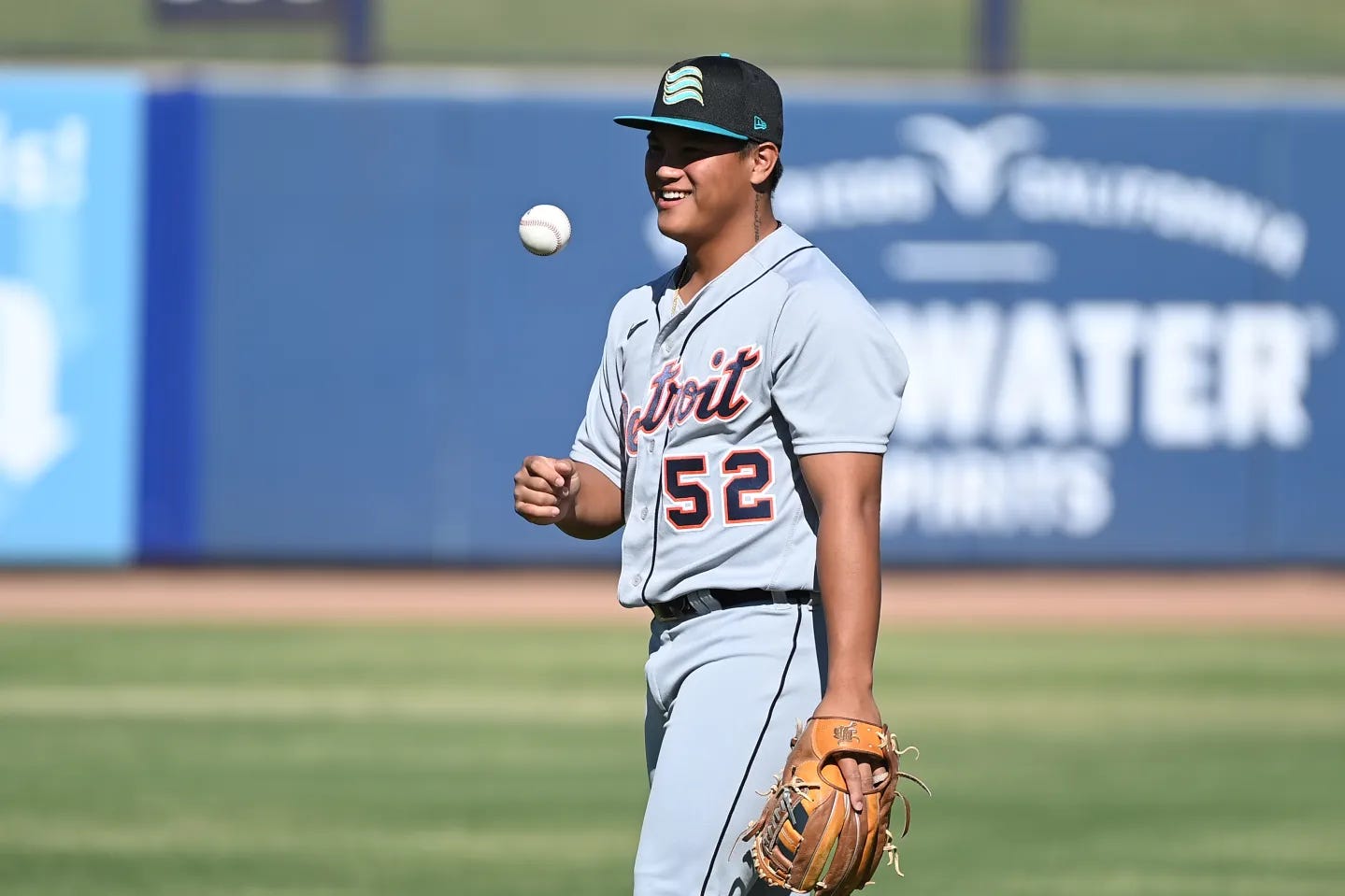
This brings us to Hao-Yu Lee, the 23-year-old Detroit Tigers rookie infielder who has the team social media Taiwanmaxxing on Threads. He is 5’9’’ and 190 lbs. So he is smaller than the average player, even in Taiwan.
But, so far, especially in the past two months, he has been hitting well in the majors. He sustained a hitting streak that went on for 12 consecutive games. He has slugged 17 extra-base hits including six home runs since being called up, slashing .333/.351/.957 in the last 15 days. By all measures, he is achieving something few other Taiwanese position players have experienced.
The last time a Taiwanese position player in MLB generated this much buzz was Yu Chang, probably in 2021 or 2022. Chang’s nine home runs with Cleveland in 2021 remain a single-season record for any Taiwanese player, and he did it in 89 games. Lee is on pace to achieve that in his rookie season.
So much for the “Taiwanese are weaker and genetically disadvantaged” theory. What Lee lacks in size he more than makes up for in raw power. He averages 90+ mph in exit velocity (recording a max of about 107 mph) and is well above average in “squared-up rate,” meaning he obtains a higher share of potential exit velocity, via squaring up the ball with the sweet spot of the bat. He has continued to improve, especially against right-handers and has plenty of room to grow as a 23-year-old rookie.
Does this mean Lee is the new face of Taiwanese baseball? It’s too early to tell. With Tsung-Che Cheng and Kai-Wei Teng, the other two Taiwanese players to have made MLB appearances this year, both optioned in July, Lee is the frontrunner by default.
But Hao-Yu Lee is hitting well and slugging against even MLB’s best pitchers?: Well, he’s an anomaly, and this year was a fluke.
Fluke or not, the act of breaking the mold has been noteworthy. Every player in the league is already a statistical anomaly, after all, and Lee is no exception. He has proven that a Taiwanese batter can compete at the highest level, and no amount of goalpost-moving changes that.
Even if Hideki Matsui and Shohei Ohtani, both iconic Asian-born sluggers, could be explained away somehow because they hailed from a neighboring country with better infrastructure, Lee’s MLB success doesn’t leave much room for the old excuses about Taiwanese hitters. Perhaps that’s enough for a few more Taiwanese youth players to start dreaming of being the next Hao-Yu Lee (instead of the next Chien-Ming Wang).
Of course Taiwan dominated Little League in the 1970s-1990s; it had a coordinated system of overtraining players and skirting eligibility rules. Of course Taiwan easily and regularly defeats teams from Western countries that aren’t the U.S.; those countries do not invest as much in baseball. The grain of truth in the lack of power hitters in Taiwan stems from the culture of small ball from youth to professional play.
Although, incidentally, Ohtani’s high school has produced fellow major leaguer Yusei Kikuchi and 2026 Miami Marlins draftee Rintaro Sasaki.